801-794-2480Contact Us

From
Training to Career

At Utah Helicopter, we’ve been setting the standard for quality training and real-world performance from the very beginning. With three dedicated training facilities and a variety of commercial operations across the Western U.S., we offer hands-on experience, high expectations, and a strong support system to help you succeed.

Our graduates have gone on to fly across the country-and even around the world. When you train with us, you’re not just earning your hours; you’re building the skills, confidence, and connection that set you apart.

If you’re ready to take your first step toward an exciting career in aviation, you’re in the right place. Let’s get you off the ground.

From
Training to Career

At Utah Helicopter, finishing your training is just the beginning. Our team of highly experienced professionals uses decades of industry relationships to help qualified pilots take their next step: whether that’s tour work, EMS, firefighting, time-building opportunities, or even positions within our own organization. We stay close to our graduates, provide guidance when needed, and open doors wherever we can. As former Chief Flight Instructor Brian “Petee” Peterson puts it, our priority is simple: helping our people succeed.

Rapid-response air medical transport supporting critical-care teams in life-saving missions. Pilots operate in dynamic environments, requiring precision, calm under pressure, and strong decision-making skills.
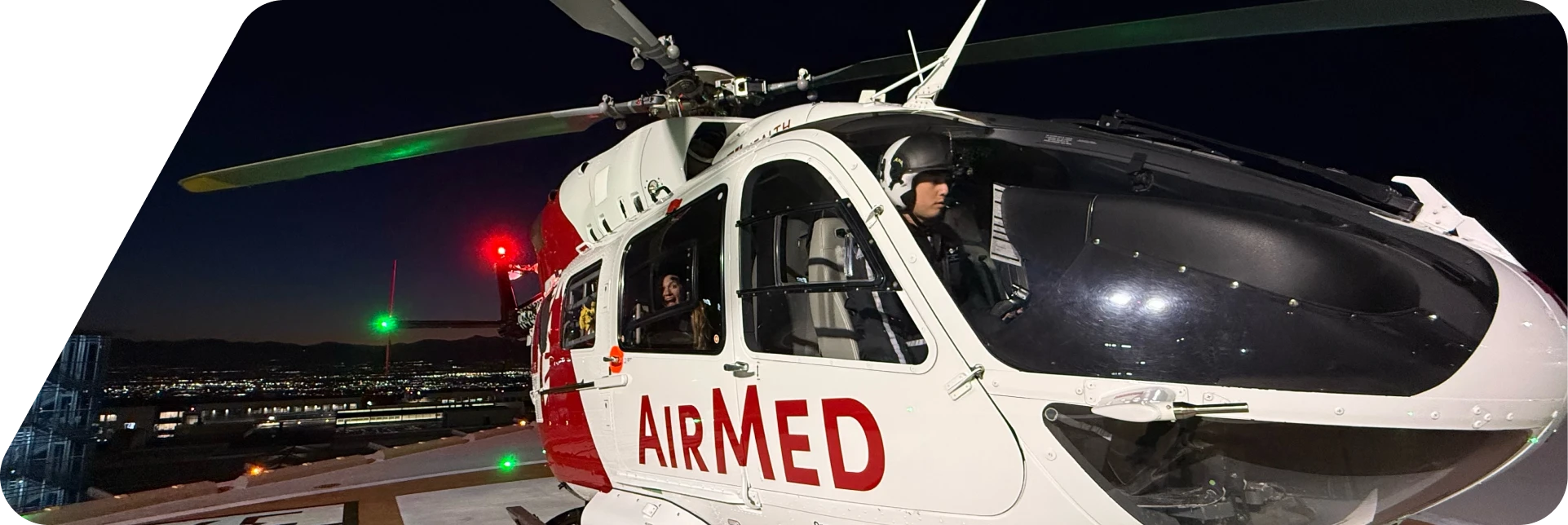
Air Medical Services

AirMed helicopter with medical crew on board parked on a helipad at night overlooking a cityscape.

Picture by Chase Eldredge. Flying for Air Med - University of Utah Health.

Scenic flights that showcase some of the most breathtaking landscapes in the country. Pilots gain extensive flight time while delivering safe, smooth, memorable experiences for travelers.

Tourism

Smiling pilot with a beard wearing a cap and sunglasses on head, standing next to a red helicopter in a desert landscape with mountains and additional helicopters in the background.

Picture by Mitch Woodbury. Flying for Papillon Helicopters - Grand Canyon

Aerial support for wildfire suppression, including water drops, crew transport, and reconnaissance. This path demands skill, discipline, and the ability to fly in challenging, high-stakes conditions.

Fire Fighting

Woman in flight suit holding a helmet standing next to a helicopter on a runway with mountains in the background.

Picture by Mariah Dugan. Flying for Rotak Helicopter Services.

Private air transport for executives and high-profile clients. Pilots provide efficient, discreet, and professional point-to-point travel while maintaining the highest safety standards.

Corporate  Hire

Woman sitting inside helicopter holding hand of man standing outside, with pilot standing nearby.

Essential transport and support for offshore drilling and energy operations. Pilots fly crews, equipment, and supplies to remote platforms while navigating long overwater routes, variable weather, and high operational standards—building strong technical skill and real-world experience.

Utility

Man in a green hoodie taking a selfie on rocky terrain with two people near a helicopter in the background on a cloudy day.

Picture by Shane Shultz. Flying for Maritime Helicopters in Homer Alaska.

Private air transport for executives and high-profile clients. Pilots provide efficient, discreet, and professional point-to-point travel while maintaining the highest safety standards.

Offshore Oil

Red and white Era helicopter with registration N553RD parked on offshore helipad by the sea.

Picture by Chris Hutchinson. Flying for Bristow.

Discovery Flights

Curious what it’s like to fly a helicopter? Our Introductory Flight is the perfect way to find out.
You’ll start by meeting our friendly office staff, who can answer any questions you have and get you checked in. Then you’ll sit down with one of our Certified Flight Instructors for a quick 15-minute safety and awareness briefing. Once that’s done, it’s time to head out to the aircraft.
Your instructor will walk you through some of the helicopter’s main components, go over a bit of pre-flight training, and then-you’re up in the air. You’ll get to try out a few basic maneuvers, feel how the controls respond, and experience what it’s like to actually fly a helicopter, with your instructor coaching you along the way. After your flight, you’ll have a chance to talk more with your instructor about training options and what the path to becoming a professional pilot looks like. Most pilots will tell you - that first flight is unforgettable. And the wild thing is, it never really gets old. Flying a helicopter is an active, hands-on challenge. It’s not just steering in a straight line- you’re constantly balancing motion and power in every direction. 
So if you’re wondering what it feels like to be on the controls… book an Intro Flight. You’ll get a feel for our training, meet the team, and most of all-you’ll know if flying helicopters is for you. We’d love to fly with you soon.

FAQ

What happens if a helicopter’s engine quits in mid-air?
In the event of engine failure, helicopters have the unique ability to maintain precise directional control and land safely—even in confined areas. What makes this possible is a descending maneuver called “autorotation.” The helicopter rotor blades are disengaged from the engine which allows the blades to continue spinning from the natural-occurring upward flow of air. Even though helicopter engine failures are exceptionally uncommon, Utah Helicopter provides extensive autorotation training.
Is it necessary to learn to fly an airplane before learning to fly a helicopter?
No. Helicopters and fixed-wing airplanes are totally different types of aircraft when it comes to their aerodynamics and operating procedures. Any knowledge about one is not a prerequisite to fly the other.
Are helicopters more restricted by high winds or bad weather?
No, helicopters’ inherent agility allow for safer maneuvering and landing in poor weather. In fact, helicopters are permitted to fly in conditions that FAA regulations restrict fixed-wing aircraft by visual flight rules (VFR).
Since helicopters do not need a runway for landing, where are they allowed to touch down other than an airport?
Helicopters may land anywhere as long as permission has been granted by the private landowner or the controlling agency of any public land. In addition, the landing must be done in a safe manner without risking lives or damage to property.
Is there an advantage in the workplace to have certificates to fly both airplanes and helicopters?
As you might suspect, the broader the spectrum of knowledge, the better; however, only a small percentage of commercial pilots are dual rated. Private corporations, U.S. Customs and border control agencies are usually the only employers seeking pilots who are certified to fly both fixed-wing aircraft and helicopters.
Are U.S. helicopter pilot certifications valid in other countries?
Some countries accept FAA certifications, while others require pilots to be certified by their own standard. The JAA is the most recognized foreign aviation regulatory agency.
How does it work to get pilot certifications and an aviation degree at the same time?
While attending flight training at Utah Helicopter Flight Academy, you can concurrently be completing online course work in Utah Valley State College’s Global Aviation Degree Program and earn either a two-year Associates degree or a four-year Bachelors degree in Aviation Science. The best part of it is that our flight training at Utah Helicopter Flight Academy will not only qualify you for FAA flight certifications, but also for the college credit you are seeking.
How do drinking, use of controlled substances and criminal records factor into being a pilot?
A criminal record or history of substance abuse can make it very difficult to qualify for FAA flight certificates. Even having misconduct after you’ve acquired your ratings, such as being cited with a vehicular DUI, can mean losing your job and/or your ratings. As a professional pilot, your personal conduct is serious business—even when you’re not flying.
What’s the likelihood of my getting financial aid to pay for flight training?
It’s our alliance with Stratus Financial that will give you an edge should you seek financial aid to fund your education. We’re considered an excellent resource for helicopter flight training, and that’s why our students are very successful in their quest to acquire financing.
Is there any benefit in the job marketplace to have flight certificates and a college degree in aviation?
Yes. The qualifications for some senior positions in the aviation industry do require a college degree; however, this is not a requirement for a majority of the helicopter pilot careers currently out there.
What’s the job market like for certified helicopter pilots?
Today’s job market is competitive, although new positions are opening every day. Many of the pilots who were trained for military duty in the Vietnam War will be retiring in the next few years. And as this retirement process progresses, there will be a surge of job opportunity in the market. A 2019 study by Boeing showed that there will be an estimated shortage of nearly 60,000 helicopter pilots through 2037..
What type of job opportunities are there for helicopter pilots?
The use of helicopters is expanding into many new markets. Just a few of the fields include: life flight, offshore transportation, tourism, law enforcement, firefighting, border patrol, VIP/corporate travel and construction.
How much money can I make as a helicopter pilot?
You can typically get your first job flying with 200-300 hours. Some low hour job opportunities include: flight instructing, aerial photography, tours, pipeline patrol, and cherry drying. Higher paying and/or more sought after jobs are more available to pilots once they reach 1,000+ hours.
How many flight hours are employers seeking?
Typically, having 300 to 3000 flight hours in your log book could qualify you to land a job. It all depends on the opportunity and the type of aircraft to be flown.
Is there an age limit for certified helicopter pilots?
To get started, a new pilot must be at least 17 years old to take the first check ride required for a Private Pilot license and be 18 years old to qualify for a Commercial Pilot license. On the other end of the spectrum, the factor that determines when it’s time to retire is health. Many pilots 65 years of age and above stop flying when they no longer meet the health requirements to maintain their flight privileges.
What type of health conditions are not permissible when seeking an FAA medical certificate?
It’s the serious physical and mental problems that could impair a pilot’s ability to fly that are red flags to FAA medical examiners. In short, color blindness, heart ailments, a history of strokes, diabetes, epilepsy, deafness or bi-polar disorder are some of the primary health issues that are scrutinized. These problems can ground seasoned pilots or disqualify flight training candidates right from the start. Aside from major health problems, if you have good eyesight (with or without correction) and sufficient hearing in both ears, it’s likely that you will qualify for the necessary medical certificates required for pilots. To be certain, we highly recommend that you see an FAA medical examiner before beginning your flight training.
Can I pay as I go?
Yes. Utah Helicopter’s payment plan is structured to allow you to pay as you go.
What flight certificates do I need to be employable?
The bare minimum you will need to be employable is a Commercial Pilot rating and a Second-Class Medical Certificate, but your chances of finding a job are greatly enhanced if you also have Instrument and Flight Instructor Certificates.
How often do I need to fly to make the best progress?
To perfect your skills, flying two to three times a week is ideal. But by bumping it up a notch and flying five times a week, you’ll get you through your training much more quickly and thoroughly master the skills to pass your exams.
Why do the costs to obtain flight training vary so much from school to school?
In all actuality, flight training costs do not vary that much in the end. It’s just that some schools quote pricing that is based upon the minimum flight time and ground school hours mandated by the FAA. The important thing to understand is that they cannot guarantee you will be able to reach proficiency and pass a flight test in that time for that cost. The unfortunate surprise for some students is that, midstream, they need more training than was expected and are required to unexpectedly pay more to finish their studies. At Utah Helicopter Flight Academy, we pride ourselves on providing outstanding flight instruction for the very best price. We cannot guarantee that you will complete training in minimum times, but we can absolutely assure that you will reach your maximum potential as a highly skilled pilot. It’s a given that cost of flight training is one of our major concerns, but your safety and our quality of instruction is our primary focus.

Feel free to reach out to us with any questions or to schedule a discovery flight:

Almost There
Oops! Something went wrong while submitting the form.

Spanish Fork, Utah (KSPK)

2050 N 300 WSpanish Fork, Utah 84660
Tel: 801-794-2480

South Valley (KSVR)

7220 S 4450 W, West Jordan, UT 84084
Tel: 801-794-2480

St. George (KSGU)

4196 S Pkwy #52G, St. George, UT 84790
Tel: 801-794-2480

© 2026 Utah Helicopter. All rights reserved.